Tokologo Tau

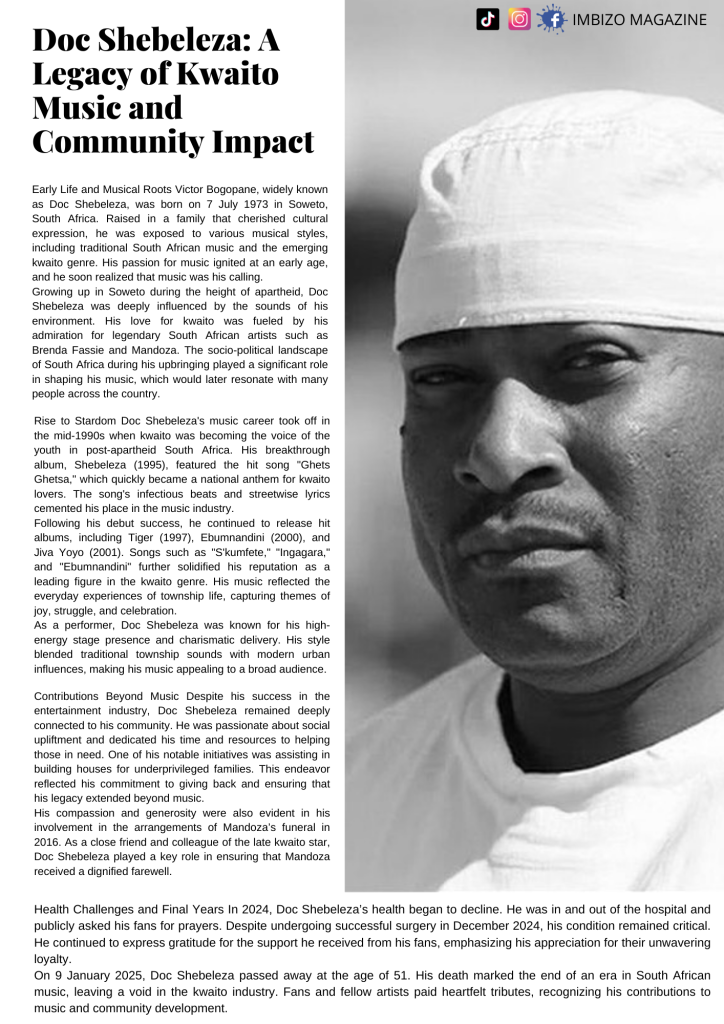
Doc Shebeleza: A Legacy of Kwaito Music and Community Impact

Early Life and Musical Roots Victor Bogopane, widely known as Doc Shebeleza, was born on 7 July 1973 in Soweto, South Africa. Raised in a family that cherished cultural expression, he was exposed to various musical styles, including traditional South African music and the emerging kwaito genre. His passion for music ignited at an early age, and he soon realized that music was his calling. Growing up in Soweto during the height of apartheid, Doc Shebeleza was deeply influenced by the sounds of his environment. His love for kwaito was fueled by his admiration for legendary South African artists such as Brenda Fassie and Mandoza. The socio-political landscape of South Africa during his upbringing played a significant role in shaping his music, which would later resonate with many people across the country. Rise to Stardom Doc Shebeleza’s music career took off in the mid-1990s when kwaito was becoming the voice of the youth in post-apartheid South Africa. His breakthrough album, Shebeleza (1995), featured the hit song “Ghets Ghetsa,” which quickly became a national anthem for kwaito lovers. The song’s infectious beats and streetwise lyrics cemented his place in the music industry. Following his debut success, he continued to release hit albums, including Tiger (1997), Ebumnandini (2000), and Jiva Yoyo (2001). Songs such as “S’kumfete,” “Ingagara,” and “Ebumnandini” further solidified his reputation as a leading figure in the kwaito genre. His music reflected the everyday experiences of township life, capturing themes of joy, struggle, and celebration. As a performer, Doc Shebeleza was known for his high-energy stage presence and charismatic delivery. His style blended traditional township sounds with modern urban influences, making his music appealing to a broad audience. Contributions Beyond Music Despite his success in the entertainment industry, Doc Shebeleza remained deeply connected to his community. He was passionate about social upliftment and dedicated his time and resources to helping those in need. One of his notable initiatives was assisting in building houses for underprivileged families. This endeavor reflected his commitment to giving back and ensuring that his legacy extended beyond music. His compassion and generosity were also evident in his involvement in the arrangements of Mandoza’s funeral in 2016. As a close friend and colleague of the late kwaito star, Doc Shebeleza played a key role in ensuring that Mandoza received a dignified farewell. Health Challenges and Final Years In 2024, Doc Shebeleza’s health began to decline. He was in and out of the hospital and publicly asked his fans for prayers. Despite undergoing successful surgery in December 2024, his condition remained critical. He continued to express gratitude for the support he received from his fans, emphasizing his appreciation for their unwavering loyalty. On 9 January 2025, Doc Shebeleza passed away at the age of 51. His death marked the end of an era in South African music, leaving a void in the kwaito industry. Fans and fellow artists paid heartfelt tributes, recognizing his contributions to music and community development.

Doc Shebeleza: A Legacy of Kwaito Music and Community Impact Read More »

Winnie Khumalo: A Trailblazer in South African Music

Winnie Khumalo was a celebrated South African singer, actress, and producer whose impact on the country’s entertainment industry spanned decades. Born on July 20, 1973, in Soweto, South Africa, she rose from humble beginnings to become one of the most recognizable voices in Kwaito and Afro-pop music. Her journey in the entertainment world was marked by perseverance, evolution, and an undying passion for music. Early Life and Career Beginnings Winnie Khumalo discovered her love for music at a very young age. Recognizing her immense talent, her family encouraged her to pursue her passion. By the age of 13, she had already entered the professional music scene, and just two years later, at 15, she released her debut album, “Hey Laaitie.” This early success cemented her status as a prodigy in the South African music industry. Rise to Prominence Throughout the 1980s and 1990s, Winnie Khumalo collaborated with some of South Africa’s biggest musical icons, including the legendary Brenda Fassie and producer Sello Chicco Twala. Her collaborations with groups such as Brothers of Peace and Bongo Maffin further showcased her versatility and ability to adapt to the evolving sound of South African music. Her influence was particularly felt in the Kwaito genre, which emerged in post-apartheid South Africa as a unique and powerful form of musical expression. Kwaito, a blend of house music, hip-hop, and traditional African sounds, provided an avenue for artists like Khumalo to connect with a new generation of fans. Breakthrough and Comeback After taking a break from music to focus on her family, Winnie Khumalo made a triumphant return in 2008 with the release of her album “I Just Wanna Live My Life.” Released under the prominent Kalawa Jazmee Records label, the album was a major success, earning gold status and cementing Khumalo’s place as a powerhouse in South African music. The title track became an anthem in clubs and on radio stations across the country, further solidifying her reputation as a queen of Afro-pop and house music.

Winnie Khumalo: A Trailblazer in South African Music Read More »

BURNA BOY: THE AFRICAN GIANT WHO CONQUERED THE GLOBAL STAGE

In the ever-evolving landscape of global music, few artists have risen to prominence with as much power, authenticity, and influence as Burna Boy. Born Damini Ebunoluwa Ogulu, Burna Boy is more than just an Afrobeats sensation; he is a cultural icon, a voice of resilience, and a testament to Africanexcellence. His journey from the streets of Port Harcourt to selling out the world’s biggest arenas is a story of determination, musical innovation, and an unrelenting belief in his identity. In this celebratory article, we explore Burna Boy’s childhood, the challenges he has faced in his career, and his remarkable achievements that have solidified him as an African Giant. Burna Boy was born on July 2, 1991, in Port Harcourt, Nigeria, into a musically inclined family. His grandfather, Benson Idonije, was the legendary manager of Afrobeat pioneer Fela Kuti, a fact that would later shape Burna’s own sound and vision. Growing up, he was surrounded by music and culture, absorbing everything from his mother’s eclectic record collection to the vibrant sounds of Nigeria’s diverse music scene. From an early age, Burna displayed a deep interest in music. He began making beats on Fruity Loops and writing his own lyrics as a teenager. His mother, Bose Ogulu, a linguist and talent manager, played a crucial role in nurturing his passion, guiding him as he honed his craft. After completing his secondary education, Burna moved to the United Kingdom for further studies, but his heart remained in music. He eventually dropped out to fully pursue his artistic ambitions, a bold decision that would set the stage for his meteoric rise. Career Challenges: Rising Above Adversity Like many great artists, Burna Boy’s journey to the top was not without its struggles. His early career was marked by industry skepticism, creative setbacks, and personal battles. His debut studio album, L.I.F.E (2013), showcased his unique blend of Afrobeats, dancehall, reggae, and hiphop, earning him recognition in Nigeria and across Africa. However, it took years before he achieved mainstream global success. Despite the promise of his talent, industry gatekeepers in Nigeria and beyond were hesitant to embrace his style, which often defied convention and challenged the status quo. In 2017, Burna faced one of the biggest controversies of his career when he was linked to an alleged assault case in Lagos. Though he denied any wrongdoing, the incident threatened to derail his rising career. However, rather than succumbing to negative publicity, Burna used the moment as fuel to refine his artistry and focus on his music. Another major challenge was breaking into the Western market. Afrobeats, despite its growing popularity, was still considered niche by many international record labels and promoters. Yet, Burna Boy’s persistence and refusal to dilute his African identity eventually forced the industry to take notice. Adversity Like Boy’s journey its struggles. marked by creative setbacks, of Afrobeats, hip-hop, Nigeria and took years mainstream global of his in Nigeria to embrace defied convention status quo. biggest controversies was linked in Lagos. any wrongdoing, to derail negative publicity, as Fuel on his breaking into still considered international record Burna Boy’s dilute his forced the Achievements: The African Giant’s Reign Burna Boy’s breakthrough moment came in 2018 with the release of Outside, featuring the hit single “Ye.”The track became an anthem, resonating with audiences worldwide and even gaining an unexpected boost when Kanye West released an album with the same title. The success of “Ye” positioned Burna Boy as a global force to be reckoned with. In 2019, he released African Giant, an album that solidified his place on the world stage. Featuring hits like “Anybody,” “Gbona,” and “Dangote, the project was a celebration of African pride, resilience, and success. It earned him his first Grammy nomination for Best World Music Album, an honor that affirmed his global impact. Not one to rest on his laurels, Burna Boy followed up with Twice As Tall (2020), executive-produced by American music mogul Diddy. This album earned him his first Grammy Award for Best Global Music Album in 2021, making him the first Nigerian artist to win a Grammy with a body of work solely his own. Beyond music, Burna Boy has cemented himself as a cultural icon. His electrifying performances have sold out iconic venues such as Madison Square Garden and the O2 Arena. He has collaborated with global superstars like Beyoncé, Ed Sheeran, and Stormzy, proving that Afrobeats is not just a genre but a global movement. Download Your Copy

BURNA BOY: THE AFRICAN GIANT WHO CONQUERED THE GLOBAL STAGE Read More »

THE SENZO MEYIWA CASE: A Summary Of An In-Depth Legal Analysis

Introduction The tragic murder of South African football star Senzo Meyiwa in October 2014 has captivated the country’s attention for nearly a decade. As one of South Africa’s most beloved athletes, Meyiwa’s death in his own home while visiting his girlfriend, Kelly Khumalo, in Vosloorus sparked immediate outcry and a series of high-profile legal proceedings. The case has undergone numerous developments, with conflicting evidence, shifting theories, and various legal challenges contributing to its protracted duration. This article seeks to provide an in-depth examination of the Senzo Meyiwa case, analyzing the legal theories, evidence presented, and procedural aspects of the case. It also delves into the public and media reaction, the delays in the trial, and concludes with an analysis of the legal perspectives surrounding the ongoing case. Background and the Initial Case Senzo Meyiwa was shot and killed in a suspected robbery at the home of Kelly Khumalo in the early hours of 26 October 2014. Meyiwa was a celebrated goalkeeper for the South African national team, and his death shocked the nation. The initial investigations pointed to an armed robbery gone wrong. However, there were several discrepancies in the accounts of the events leading up to his death, and suspicions quickly arose that the case may have been more complicated than initially believed. Over the years, several suspects were arrested and charged in connection with the murder, but the evidence against them remained largely circumstantial, leading to multiple delays in the trial. In the years following Meyiwa’s death, new developments in the case have continuously emerged, including contradictions in witness statements, inconsistencies in police procedures, and changes in the charges brought against various individuals. The Current Case: New Findings and Developments As of 2024, the case has moved into a critical phase with the trial of five men accused of Meyiwa’s murder. In 2020, the National Prosecuting Authority (NPA) formally charged the suspects, including Fisokuhle Ntuli, Thokozani Ngcobo, and others. The accused individuals have all pleaded not guilty, and the defense has mounted significant challenges against the prosecution’s case. The evidence in the current case includes eyewitness testimonies, forensic evidence, and surveillance footage. The state has alleged that the accused men were involved in a planned robbery that escalated into the shooting of Meyiwa. However, questions have been raised about the reliability of the witnesses, some of whom have since changed their statements. Furthermore, the defense argues that the police investigation was flawed from the outset, with crucial evidence potentially mishandled. Theories Presented: State vs. Defense The primary legal theories presented by the state and the defense diverge significantly. The state’s theory is that the accused were involved in a botched robbery attempt, which resulted in Meyiwa’s death. The prosecution has argued that the accused were present at the scene and engaged in an altercation with Meyiwa, during which the fatal shot was fired. Evidence supporting this theory includes cellphone records, which allegedly show communication between the accused before and after the murder, and eyewitness testimony from Kelly Khumalo and others present at the scene. In contrast, the defense has consistently challenged the integrity of the investigation and the validity of the prosecution’s evidence. The defense contends that the case is based on weak circumstantial evidence, relying heavily on unreliable witness testimony. The defense has also presented an alternative theory that suggests the murder may have been an inside job, potentially linked to personal disputes or other motives unrelated to the robbery.

THE SENZO MEYIWA CASE: A Summary Of An In-Depth Legal Analysis Read More »

PANDA KAU : REDEFINING URBAN FASHION WITH ZAZA MOSIA

In the world of streetwear, where culture and fashion collide, Panda Kau has emerged as a groundbreaking brand. Designed and owned by Zaza Mosia, the label has quickly become a symbol of bold self-expression, creativity, and cultural pride. With its distinctive aesthetic and uncompromising quality, Panda Kau is setting a new standard for urban fashion in South Africa and beyond. WHAT’S NEW IN THE FASHION WORLD?A Vision Brought to LifePanda Kau was born from Zaza Mosia’s vision to create a brand that transcends the typical streetwear model. Combining urban style with a unique blend of traditional influences and modern trends, Zaza has successfully cultivated a brand that speaks to the youth of today. Each piece of clothing reflects not only the latest fashion trends but also a sense of pride in one’s heritage and individuality. Zaza’s journey into fashion began as a passion for personal style, which later grew into a commitment to creating wearable art that tells a story. Panda Kau’s collections focus on high-quality materials, vibrant designs, and street-inspired graphics that resonate with both local and international audiences The Panda Kau AestheticThe aesthetic of Panda Kau is deeply rooted in the diverse urban culture of South Africa. Each collection is a fusion of bold colors, strong graphic elements, and innovative designs, often incorporating elements from traditional African motifs. Panda Kau doesn’t just follow trends; it sets them, with pieces that challenge the norms of what streetwear can be. The brand’s logo, a sleek and modern representation of a panda, has become a recognizable symbol of the company’s commitment to originality. The panda, known for its balance of strength and gentleness, embodies the dual spirit of the brand—grounded in street culture yet offering a sense of calm, individuality, and inclusivity. Download Your Copy

PANDA KAU : REDEFINING URBAN FASHION WITH ZAZA MOSIA Read More »

A South African Dance Music Prodigy Conquering the Global Scene

Bun Xapa is a name that’s rapidly gaining recognition in the global dance music scene. With his roots firmly planted in South Africa, this emerging DJ and producer is steadily making waves across the world, shaping the future of dance music. His unique sound and infectious energy have resonated with audiences in multiple countries, propelling him to the forefront of the genre. Early Life and Musical RootsBorn in South Africa, Bun Xapa’s musical journey began at a young age. Growing up in a country with a rich cultural tapestry and a deep connection to music, he was exposed to various genres, from Afrobeat to house music, which have greatly influenced his sound. South Africa, known for producing world-class artists in many musical genres, played a crucial role in shaping Xapa’s artistic direction. Bun Xapa’s early experiences were shaped by the vibrant music scene in South Africa, where genres like kwaito, house, and amapiano dominate the airwaves. The diversity of sounds and the deep-rooted rhythm in South African music instilled in him a desire to fuse traditional elements with modern, global dance music. As a young musician, Xapa began experimenting with different sounds and styles, blending African rhythms with contemporary beats. His fascination with the art of music production grew as he started learning the technical aspects of sound design and beat-making. Drawing inspiration from both his heritage and global dance trends, he set out to carve a niche for himself in the highly competitive world of dance music. Career Breakthrough and EvolutionBun Xapa’s rise to prominence can be traced back to his determination to create a distinctive sound. While South Africa is known for producing various dance music genres, Bun Xapa’s style combines the best of global dance elements, blending deep house, tech house, and Afrobeat influences into a seamless mix that is both innovative and captivating. His breakthrough came after several years of perfecting his craft and experimenting with different sounds. What truly set Xapa apart was his ability to merge African-inspired rhythms with cutting-edge electronic music. This fusion captured the attention of dance music enthusiasts both in South Africa and abroad, giving him a solid fanbase early in his career. Bun Xapa’s global breakthrough came with the release of his debut single, which quickly gained traction in international markets. His ability to capture the spirit of dance culture with an African flair resonated with listeners, propelling him onto global playlists and into the hearts of fans worldwide. Download Your Copy

A South African Dance Music Prodigy Conquering the Global Scene Read More »

YUHL HEADMAN: A TRAILBLAZER IN DANCE AND ARTS MANAGEMENT

Yuhl Nala Headman’s name resonates within South Africa’s arts and cultural landscape. Born in Cape Town’s vibrant Kwalanga township, Yuhl’s journey is a testament to resilience, passion, and dedication. With roots in a musical family steeped in jazz and African rhythms, he discovered his artistic calling early in life, progressing from choreographing Kwaito-inspired dance routines with friends to gracing international stages. Today, Yuhl is celebrated as a dancer, choreographer, arts administrator, and activist committed to uplifting South Africa’s creative industries. Yuhl’s love for the arts was cultivated during his school years, where he explored instruments like the piano, trumpet, and guitar. However, it was his leadership in choreographing dance routines inspired by Kwaito legends such as Trompies and Alaska that solidified his artistic path. His talent did not go unnoticed, and he was recruited by Mputseng Shuping of the Jazzart Dance Theatre, one of Cape Town’s premier contemporary dance companies. This pivotal moment led Yuhl to enroll at the UCT School of Dance, where he earned his Dance Teachers and Performance Diploma in 2004. Guided by mentors like Xolani Maxwell Rani, he honed his craft, laying a foundation for his illustrious career. From productions like “PETRA” with The Forgotten Angle Collaborative to performing for the prestigious Moving into Dance company, Yuhl consistently demonstrated versatility and innovation. Yuhl’s contributions extend beyond performance. His work with Artscape Opera as an assistant choreographer and dancer in productions like Treemonisha showcased his ability to bridge artistic disciplines. Touring Europe with these productions expanded his horizons and deepened his understanding of the global arts scene. Nationally, Yuhl has been part of monumental events such as the FIFA World Cup South Africa 2010 and AFCON 2012, where he performed on stages viewed by billions. These moments not only marked personal achievements but also highlighted South Africa’s rich cultural tapestry on the world stage. His role as assistant choreographer for Big Brother Africa Revolution further underscored his ability to blend commercial appeal with artistic integrity. Download Your Copy

YUHL HEADMAN: A TRAILBLAZER IN DANCE AND ARTS MANAGEMENT Read More »

The Multifaceted Journey of Nonkululeko: Nurse, Actor, Beauty Queen, and Advocacy

Nonkululeko’s story is a powerful narrative of determination, compassion, and an unyielding pursuit of excellence. From humble beginnings to becoming a crowned queen of Miss Stella South Africa 2024/2025, her journey reflects resilience and the ability to overcome numerous challenges. With a career spanning nursing, acting, beauty pageantry, and advocacy, Nonkululeko embodies the essence of a modern trailblazer — one who refuses to be defined by a single role. The Early Years: Nursing as a Calling Nonkululeko’s passion for nursing was ignited in childhood after her father underwent a critical spinal operation. Witnessing her mother’s selfless care for him, she learned the value of compassion. This experience planted a seed that would later blossom into a career in healthcare. Her formal journey into nursing began after completing a short course in Information Technology (IT). She applied to the Chris Hani Baragwanath Nursing College, where she was accepted after rigorous psychometric tests and interviews. Contrary to her initial belief that nursing was limited to administering injections and dispensing pills, she discovered that it required empathy, patience, and an ability to connect deeply with patients. Noluthando’s journey in nursing has been one of continuous growth. She pursued further studies in occupational health nursing science at the University of Johannesburg and later specialized in the field. Her work as an occupational health practitioner within the mining and industrial sectors showcases her commitment to healthcare beyond hospital walls. Today, she also operates her own mobile health practice and serves as an advocate for medical and nursing professionals, ensuring ethical and lawful practices are upheld in the healthcare system. The Actress: From the Small Screen to the Big StageNonkululeko’s foray into acting was driven by childhood dreams of seeing herself on television. Inspired by South African children’s programs like Kideo, she declared to her mother that one day she, too, would be on TV. This dream took shape in 2016, leading to her first role on Isinji, a Mzansi Magic drama series, where she played the lead role of Thandeka. Relocating to Johannesburg in 2017 was a pivotal moment for her acting career. She enrolled at the Market Theatre Laboratory, attending theater acting classes every Saturday while also managing her full-time nursing career. Nonkululeko’s acting credits now include appearances in hit South African shows such as Generations, Ring of Lies, Side Dish (Netflix), and Ufe Lani. Her role as Dr. Kate on SABC1’s Boarding School solidified her presence on the small screen. Her passion for acting extends beyond television. She finds theater acting to be more immersive, though she admits that television offers greater exposure. Despite the demands of her nursing career, Nonkululeko continues to push boundaries as an actress, juggling multiple roles while maintaining her commitment to excellence. The Queen: Redefining Beauty and Pageantry Nonkululeko’s journey in pageantry began in primary school, where she was consistently selected as a class representative for Miss Valentine’s Day competitions. Though she often emerged as the first or second princess, her desire to wear the crown never faded. Her entry into pageantry as an adult was driven by a desire to challenge the stereotypes around beauty standards. She competed in Miss Plus SA, which embraces women with diverse body types. Her performance as a humanitarian ambassador allowed her to showcase her commitment to charity work, a value instilled in her from childhood by her parents. Her crowning moment came on April 6, 2024, at Bloemfontein City Hall, where she was named Miss Stella South Africa 2024/2025. This title represents not just personal victory but also a triumph for women across the country. Noluthando will represent South Africa at the Miss Stella World competition in Atlanta, Georgia, in 2025, becoming the first queen from her category to compete internationally. Her goal is to bring the crown home, inspiring women of all shapes, sizes, and backgrounds to see beauty within themselves. Through her advocacy work as a pageant queen, Nonkululeko promotes the prevention of violence, physical abuse, and sexual abuse against women and children. Her work extends to supporting community-based initiatives, charity drives, and educational campaigns. As a queen, she views herself not as a figure of glamour but as a servant to her community. The Advocate: Championing Justice and Accountability Nonkululeko’s decision to pursue law was inspired by a deep sense of justice. Her experiences in healthcare exposed her to medical negligence cases, where she saw a need for legal practitioners with medical knowledge. She now seeks to bridge the gap between healthcare and the law by advocating for medical malpractice victims and representing healthcare professionals accused of negligence. Her entry into the legal field was further encouraged by her exposure to organizations such as BLASC (Black Lawyers Association Student Chapter). She appreciates the support and community offered by the organization, which provides shadowing opportunities, study support, and mentorship. Through this support, she aims to become an advocate for medical justice, defending the vulnerable and ensuring accountability within the healthcare sector. Nonkululeko is clear in her principles. She refuses to defend individuals she believes are guilty of wrongdoing, stating that she would rather lose a client than compromise her integrity. Her passion for justice extends beyond the courtroom. She hopes to one day open her own law firm, providing legal aid and representation for nurses, doctors, and patients alike. Download Your Copy

The Multifaceted Journey of Nonkululeko: Nurse, Actor, Beauty Queen, and Advocacy Read More »

Broken Net in the Final Whistle: A Theatrical Reflection on Justice, Grief, and Reconciliation in South Africa

 Theatre has long served as a mirror to society, reflecting its deepest pains, struggles, and triumphs. Broken Net in the Final Whistle is one such production — a gripping, thought-provoking South African play inspired by a true event that continues to haunt the nation. This historical moment, which remains etched in the collective conscience of the people, is masterfully reimagined on stage, forcing audiences to confront the complexities of justice, grief, and reconciliation in post-apartheid South Africa.  At the heart of Broken Net in the Final Whistle lies a pivotal event that exposed the fragility of justice in South Africa. Though the specific historical moment is not explicitly stated, it is clear that its echoes are felt in every scene. The event serves as a point of reflection for the entire nation — a reminder of unresolved trauma, the pain of loss, and the slow, uneven path toward healing. The play’s title evokes a powerful metaphor, suggesting that something essential has been broken, yet the “final whistle” implies a reckoning or conclusion that may never fully arrive.  The play unfolds through the lives of its characters, each representing different facets of South Africa’s social, legal, and emotional landscape. Their personal journeys give voice to the unseen and unheard. The characters are not mere symbols but fully developed human beings grappling with grief, disillusionment, and hope. Their stories intertwine, reflecting the larger societal struggles of a nation still haunted by unresolved historical injustices. Through their experiences, the audience is invited to see beyond the headlines and legal proceedings, witnessing the raw emotional impact of a broken system.  Download your Copy

Broken Net in the Final Whistle: A Theatrical Reflection on Justice, Grief, and Reconciliation in South Africa Read More »

THE IMPORTANCE OF SAFETY DURING VACATIONS IN SOUTH AFRICA: PROTECTING YOURSELF AND YOUR LOVED ONES

South Africa is a country known for its breathtaking landscapes, vibrant culture, and diverse attractions, from the iconic Table Mountain to the wildlife-rich Kruger National Park. As a popular vacation destination, it offers tourists an array of unforgettable experiences—whether you’re enjoying the sunny beaches of Durban, the historical sites in Johannesburg, or the scenic beauty of the Garden Route. However, like any travel destination, it is crucial to prioritize safety during your stay to ensure that your holiday remains an enjoyable and memorable experience. While South Africa is a dream destination for many, it is also important to be aware of certain safety considerations that will help minimize risks and allow you to make the most of your trip. This article discusses the importance of safety while vacationing in South Africa, offering practical advice and tips for travelers. The Importance of Safety During Vacations in South Africa: Protecting Yourself and Your Loved OnesSouth Africa is a country known for its breathtaking landscapes, vibrant culture, and diverse attractions, from the iconic Table Mountain to the wildlife-rich Kruger National Park. As a popular vacation destination, it offers tourists an array of unforgettable experiences—whether you’re enjoying the sunny beaches of Durban, the historical sites in Johannesburg, or the scenic beauty of the Garden Route. However, like any travel destination, it is crucial to prioritize safety during your stay to ensure that your holiday remains an enjoyable and memorable experience. While South Africa is a dream destination for many, it is also important to be aware of certain safety considerations that will help minimize risks and allow you to make the most of your trip. This article discusses the importance of safety while vacationing in South Africa, offering practical advice and tips for travelers. Understanding the Need for SafetySouth Africa is a country of contrasts, and while it is home to world-class tourism infrastructure, it also faces challenges related to crime and public safety in some areas. However, it’s essential to remember that millions of tourists visit South Africa every year without incident, enjoying all that the country has to offer. The key to having a successful vacation is being prepared, staying alert, and exercising caution. Safety is essential for:1.Ensuring personal well-being: By staying vigilant and prepared, you minimize the risk of theft, injury, or harm.2.Protecting your belongings: South Africa is known for having some areas with high rates of theft, particularly in crowded tourist hotspots. Taking measures to safeguard your personal items is crucial.3.Enhancing your experience: Peace of mind allows you to fully enjoy the natural beauty, rich history, and unique culture of South Africa.4.Supporting local tourism: A safe and enjoyable experience encourages you to recommend South Africa to others and supports the local economy and hospitality industry. Safeguarding Your Experience: Safety at South African Beaches, Wildlife Reserves, and Cultural SitesSouth Africa boasts a diverse range of natural wonders, including pristine beaches, renowned national parks, and culturally significant landmarks. Here are a few safety tips for specific attractions: •Beaches: South Africa’s beaches are popular for their beauty and water sports. However, be mindful of rip currents and never swim alone. Pay attention to warning signs about shark activity or dangerous tides. Some beaches, especially in cities like Cape Town and Durban, have lifeguards during peak times—so ensure you’re swimming in safe zones. •Safari and Wildlife Reserves: South Africa is home to some of the world’s most famous safari destinations, including Kruger National Park and Addo Elephant Park. Always follow the guidance of experienced rangers and stay within designated safe areas. Never attempt to approach wild animals, even from a distance, and ensure your vehicle doors are locked when driving through reserves. •Cultural Sites: South Africa is rich in cultural and historical landmarks, including Robben Island, the Apartheid Museum, and various heritage sites in the Eastern Cape. While these areas are generally safe for tourists, always remain vigilant when exploring unfamiliar places and keep your personal belongings close.

THE IMPORTANCE OF SAFETY DURING VACATIONS IN SOUTH AFRICA: PROTECTING YOURSELF AND YOUR LOVED ONES Read More »

Shopping Cart
Scroll to Top