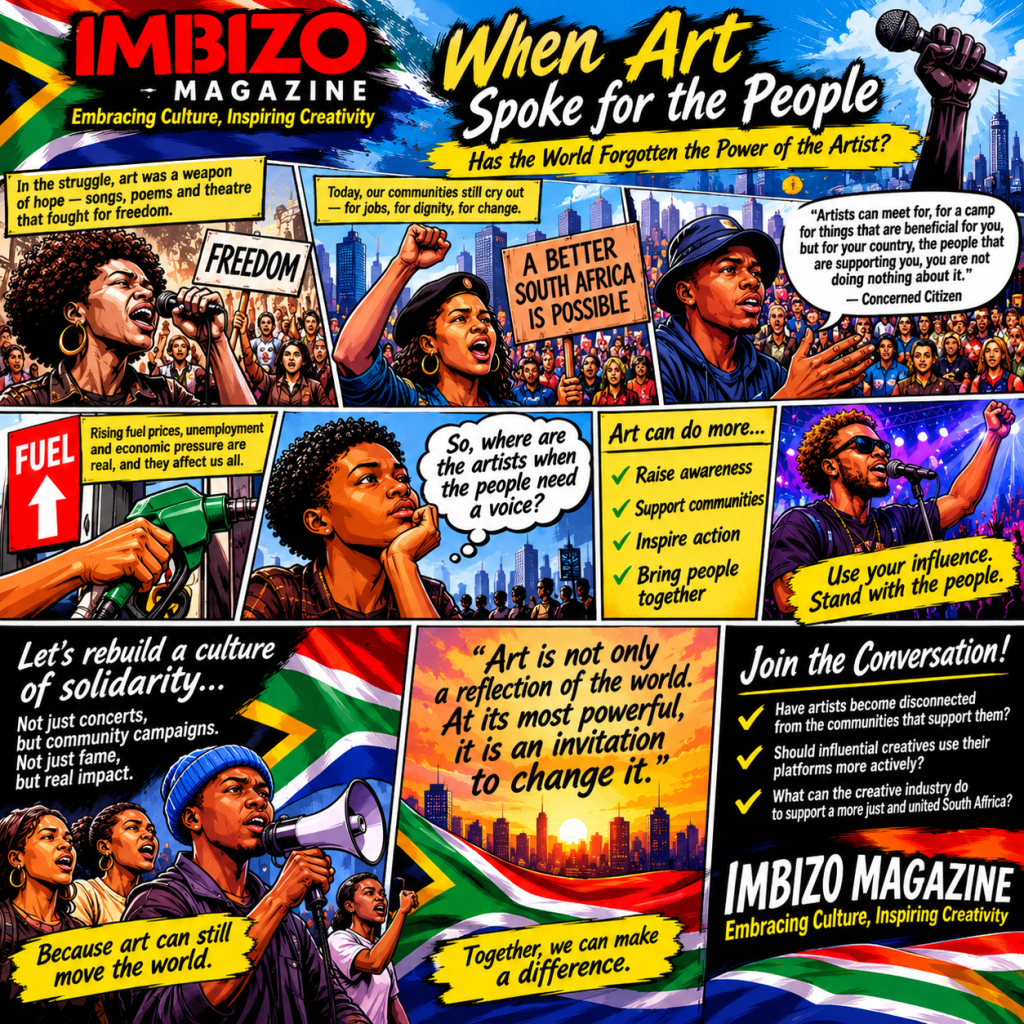
From the songs of liberation to the struggles of a new generation, art has always had the power to challenge injustice, awaken consciousness and give a voice to those who feel unheard. But in a world grappling with economic hardship, social inequality and growing frustration, are we still using that power to its fullest?
There was a time when a song was more than a melody, a poem was more than a collection of words, and a theatre performance was more than entertainment. Art carried the pain of a people, the hopes of a generation and the courage of those who dared to imagine a different world. It travelled where ordinary conversations could not, spoke when fear silenced people and brought strangers together through a shared understanding of their struggles.
In South Africa, the arts played an important role in the fight against apartheid. Musicians, poets, actors, writers and cultural activists used their talents to challenge oppression, preserve cultural identity and communicate messages of freedom. Through struggle songs, political theatre, protest poetry and music performed across borders, artists helped ensure that the experiences of ordinary people were heard beyond the communities in which they lived. Their work reminded the world that behind every political decision were human beings whose dignity, freedom and futures were at stake.
Art did not end oppression on its own. It worked alongside organised resistance, political movements, community action and the sacrifices of countless people. Yet its contribution was undeniable: it helped people find courage, express their anger, preserve their humanity and believe that change was possible.
A song could turn grief into determination. A poem could give language to an injustice that people had struggled to explain. A stage could become a place where society confronted the truths it preferred to hide. Art gave emotion a voice and transformed individual pain into a collective experience.
But today, as another generation confronts its own uncertainties, an uncomfortable question deserves our attention: where does the power of the artist stand in the struggles of our time?
Across communities in South Africa and around the world, young people continue to raise their voices about the conditions shaping their futures. Questions of employment, inequality, access to opportunities, public services, accountability and the cost of living remain part of the public conversation. Rising fuel prices place additional pressure on transport costs, food prices and household budgets, affecting working-class communities, young people and small businesses.
These realities are not distant from the creative community. The artist who struggles to afford transport to a performance understands the pressure of rising costs. The emerging filmmaker who cannot secure equipment or production funding understands the weight of limited opportunities. The musician who spends months creating work without financial security knows what it means to pursue a dream in an environment where survival cannot be postponed.
Artists are part of the same society they create for. They experience its challenges, depend on its opportunities and share in its hopes. Their lives are intertwined with the communities whose stories they tell.
And yet, when we look at the relationship between art and social causes today, we must ask whether we are doing enough to turn our creative influence into meaningful collective action.
The conversation becomes even more significant when we listen to the concerns of ordinary citizens.
In a passionate appeal directed at influential artists, musicians, DJs, entertainers and social media personalities, one concerned citizen questioned why people with significant platforms and audiences are not more visibly involved in addressing challenges affecting the country.
The citizen’s argument was not simply that artists should speak about social issues. It was that the very communities supporting their careers deserve to see that support translated into something meaningful when society faces difficult moments.
One particularly striking statement from the appeal was:
“You can never throw enough thank-you parties to thank South Africa for the support that they’ve been giving you.”
The citizen challenged artists to look beyond entertainment events, celebrations, brand partnerships and commercial success, and consider how they could mobilise the people who follow, stream, purchase tickets and support their work.
The appeal also drew attention to an uncomfortable social reality: some of the people who continue to show up in moments of community struggle are those with the least financial security and fewest privileges.
The citizen questioned why unemployed people and residents from disadvantaged communities are often among those taking to the streets, while some influential personalities appear disconnected from the struggles being raised.
The message was particularly directed at those who enjoy the benefits of large audiences and commercial success but may not use their platforms to raise awareness about issues affecting those same audiences.
One of the strongest sentiments was that influence should mean more than encouraging people to purchase products, attend events or follow lifestyles they may not be able to afford.
As the citizen expressed:
“If you can meet for celebrations, you can meet for this issue and make sure that you spread the word.”
The appeal was ultimately a call for solidarity. It encouraged influential personalities to bring communities together, amplify information, support peaceful collective action and recognise that leadership does not only belong to people holding public office.
It also acknowledged that people have different circumstances, safety concerns and ways of participating. The underlying message was that everyone, regardless of their platform or position, can find meaningful ways to contribute.
This is a powerful perspective because it challenges the relationship between influence and responsibility. It asks whether public recognition should be measured only by the number of followers, views or commercial opportunities someone attracts, or also by the positive contribution they make to the lives of others.
It is important to recognise that this is one citizen’s perspective, not necessarily a reflection of every artist or public personality. Artists have different circumstances, and some are already contributing to social causes in ways that may not receive widespread attention. Nevertheless, the frustration deserves to be heard.

The citizen’s appeal brings us back to another difficult question: have we become so occupied with building individual careers that we have forgotten the value of building something together?
Have streaming numbers, brand partnerships, bookings, celebrity status and the pursuit of commercial success changed the way we understand our responsibility to society? Or are artists still speaking, but in ways that audiences, institutions and the media have not fully recognised?
Perhaps the answer is more complicated than simply declaring that today’s artists are silent.
The creative industry has changed. Digital platforms have created opportunities for artists to reach millions of people without relying on traditional media. Social media can expose injustice, amplify community campaigns and bring attention to issues that might otherwise go unnoticed. Some artists continue to support social causes through benefit performances, fundraising, community projects, advocacy and the messages contained in their work.
But visibility is not always the same as impact. A message can attract thousands of views and disappear within hours. A trending hashtag can create a moment of outrage without building a lasting campaign. A powerful song can move an audience emotionally without necessarily inspiring people to take action.
This raises another difficult question: are we creating art that merely reflects the world, or are we also creating art that challenges us to change it?
There is a difference between acknowledging pain and confronting its causes. There is a difference between singing about hardship and helping communities find the courage, solidarity and platforms to address it. Both forms of expression have value, but when the two meet, art can become something greater than a product consumed for a few minutes before the next song, video or headline takes its place.
We must also recognise the pressures artists face. An emerging musician may depend on a sponsor to fund a project. An actor may fear losing future opportunities by speaking on a controversial subject. A creative entrepreneur may worry that public advocacy could alienate potential clients. Others may feel that speaking out will achieve little when the challenges they highlight appear to persist.
These concerns should not be dismissed. Artists are workers, business owners, parents and members of communities. They have the right to protect their livelihoods, choose their causes and determine how they express themselves. No artist should be expected to risk their safety or career simply to prove their commitment to society.
However, we should not allow these realities to close the conversation. Instead, they should encourage us to ask how the creative industry can create environments in which artists can speak honestly, collaborate meaningfully and support causes without carrying the burden alone.
What role do promoters, record labels, broadcasters, cultural institutions, sponsors and audiences play in this conversation? If we celebrate artists when they entertain us but withdraw our support when they address uncomfortable truths, what does that say about the kind of creative freedom we claim to value?
Freedom of expression cannot be meaningful only when the message is commercially convenient. It must also leave room for difficult questions, differing opinions, uncomfortable experiences and the voices of people who might otherwise be ignored.
At the same time, activism should not become another performance designed solely for public approval. Speaking about a cause is important, but so is listening to affected communities, understanding the issues and supporting responsible, sustained efforts to address them.
Not every artist needs to lead a march. Not every campaign needs a famous face. Sometimes the most meaningful contribution is a community workshop, a benefit concert, a platform for overlooked voices, a truthful documentary or a song that helps people understand one another.
Imagine the impact if musicians came together to raise awareness about youth unemployment. Imagine theatre practitioners creating productions that help communities confront violence, discrimination or social exclusion. Imagine poets documenting the experiences of families struggling to make ends meet, photographers recording the realities of overlooked neighbourhoods, and filmmakers preserving stories that might otherwise disappear.
Imagine established artists opening doors for emerging talent, using their platforms to amplify community organisations and creating campaigns that continue long after the cameras are switched off.
What if artists, DJs, actors, influencers, writers and cultural organisations used their collective reach to promote community dialogue, encourage civic participation, support local initiatives and create opportunities for those who are often excluded?
This does not mean that every creative must share the same political position or participate in the same campaign. It means recognising that social responsibility can exist alongside creative freedom, commercial success and individual ambition.
Today’s challenges are different, the media landscape has changed, and young people have developed new ways of organising, communicating and demanding accountability. What matters is not whether contemporary artists recreate the activism of previous generations, but whether they discover meaningful ways to use their own voices, talents and platforms in the world they inhabit.
Perhaps the real concern is not that art has lost its power, but that we have become accustomed to consuming that power without asking what it could accomplish.
We stream the songs. We applaud the performances. We share the videos. We celebrate the awards. We follow the personalities. Yet how often do we ask what our creative culture is saying about the society we are building?
How often do we create space for artists to discuss the issues affecting their communities, beyond album launches, celebrity news and commercial announcements?
And what responsibility do we, as audiences and media platforms, have in making those conversations possible?
At Imbizo Magazine, this is a conversation worth opening because culture is not separate from the lives of the people who create it. The arts are part of how communities remember, question, heal, celebrate and imagine their futures.
When the stories of ordinary people disappear from our creative spaces, we risk losing more than a particular style of music or performance. We risk losing opportunities to understand one another.
History reminds us that the power of art has never depended solely on the fame of the person holding the microphone. It has often depended on the truth of the message, the courage to express it and the willingness of people to carry it forward.
A young poet speaking at a community gathering can raise a question that an entire neighbourhood has been afraid to ask. A local musician can tell a story that helps a generation recognise its shared experiences. An independent filmmaker can reveal a reality that challenges comfortable assumptions. These contributions may not always make headlines, but their value cannot be measured by popularity alone.
We should also be careful not to romanticise the past. Not every artist participated in the liberation struggle, and not every contemporary artist has turned away from social responsibility. The purpose of looking back is not to judge an entire generation against another. It is to remember what becomes possible when creativity connects with a larger human purpose.
The world does not need artists to have all the answers. It needs spaces where questions can be asked, where suffering can be acknowledged, where different perspectives can be heard and where people can imagine possibilities beyond their present circumstances.
A song cannot independently lower the cost of living. A poem cannot create jobs on its own. A play cannot replace effective public services or accountable institutions. But art can help people understand why these issues matter, bring overlooked experiences into public view, encourage solidarity and inspire communities to participate in the search for solution, that is a power worth protecting.
As a new generation raises questions about its future, perhaps it is time for the creative industry to reflect on the legacy it wants to leave behind.
Will our era be remembered only for its viral moments, commercial successes and celebrated personalities? Or will it also be remembered for the stories we told, the communities we supported, the injustices we confronted and the opportunities we helped create for others?
The answer will not come from artists alone. It will be shaped by audiences, institutions, media organisations, sponsors, community leaders and everyone who believes that culture has a place in building a more just and compassionate society.
The microphone is still powerful. The pen is still capable of challenging a system of thought. The stage can still become a meeting place for difficult truths. The camera can still preserve the experiences of people who are rarely heard. And a story, told with honesty and courage, can still change the way someone sees the world.
Perhaps the question we should leave with is not simply, where are the artists?
Perhaps it is this: what kind of world are we creating with our art, and who are we creating it for?
Because when the music stops, the performance ends and the applause fades, the world outside the venue remains. People still have dreams to pursue, communities still have challenges to overcome, and young people still need reasons to believe that their voices matter.
Art has always had the capacity to help us see beyond what is. The challenge before us is to ensure that it continues to help us imagine, question and work towards what could be.
Art is not only a reflection of the world. At its most powerful, it is an invitation to change it.
Imbizo Magazine invites musicians, DJs, actors, influencers, cultural practitioners, industry stakeholders and readers to respond to this conversation.
Have artists become disconnected from the communities that support them? Should influential creatives use their platforms more actively to raise awareness about social challenges? And what can the creative industry do collectively to make a difference?
We want to hear from you. Let us move beyond the applause and have an honest conversation about the power, purpose and responsibility of art.
Imbizo Magazine — Embracing Culture, Inspiring Creativity.