
South Africa’s creative economy is contributing billions to the national economy and supporting millions of livelihoods, but access to finance remains one of the biggest challenges facing creatives and cultural businesses.
The South African Cultural Observatory (SACO) is set to bring new evidence to this debate when it presents findings from its “Cultural and Creative Industries Economic Trends over the Last 10 Years” report at the Creative Cnergy Policy & Investment Symposium 2026 on Thursday, 3 September 2026, at AlexForbes in Sandton. The findings will be discussed during a fireside chat featuring SACO Executive Director Unathi Lutshaba and cultural figure and academic Prof. Pitika Ntuli.
The report examines trends across South Africa’s cultural and creative industries over a ten-year period, with a particular focus on the financial realities facing the sector.
According to SACO’s most recent 2024 mapping, the cultural, creative and sport industries collectively contribute an estimated R271 billion to South Africa’s GDP, representing almost 4% of the national economy. The sectors also support approximately 1.4 million jobs.
However, the economic contribution of the sector does not necessarily translate into easy access to funding for individual creatives, organisations and creative businesses.
SACO’s research highlights the structural challenges that make the creative sector difficult to finance through traditional lending models. More than a third of people working in South African cultural occupations operate as freelancers or own-account workers — a rate more than three times higher than that found elsewhere in the economy.
For many creatives, this means irregular income, project-based work and business models that may not fit conventional requirements used by banks and other financial institutions when assessing borrowers.
SACO Executive Director Unathi Lutshaba says the report is intended to provide financial institutions and policymakers with stronger evidence about the sector.
“South Africa’s creative and cultural industries have shown real, measurable growth over the past decade, yet access to finance has remained uneven because the underlying evidence has rarely been assembled in a form that banks and investors can act on,” said Lutshaba.
She said the report brings together ten years of information covering different areas of the sector, including digital platforms and international trade.
“Our hope is that it moves the conversation from describing the sector’s potential to financing its growth,” she said.
For creative entrepreneurs, the question is increasingly not whether the sector has economic value, but whether the financial system is adequately structured to support the businesses operating within it.
The discussion comes at a time when public funding for cultural and creative industries has faced pressure internationally.
At the same time, South Africa’s creative sector continues to produce businesses, artists, cultural organisations and independent practitioners who contribute to employment, tourism, cultural development and the wider economy.
Lutshaba argues that better evidence could help investors identify where funding is most needed and where viable opportunities exist.
“Creatives across the country continue to build sustainable businesses despite limited access to capital, and this report sets out, in detail, where that capital is most needed and where the opportunities for investors actually lie,” she said.
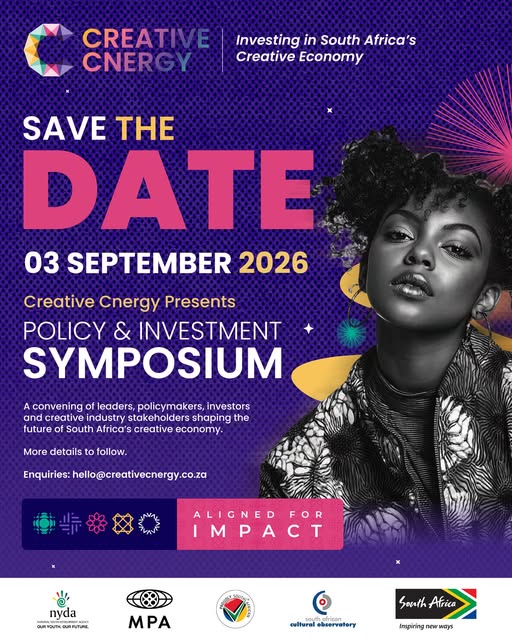
The Creative Cnergy 2026 programme will also explore other issues affecting the future of the creative economy, including artificial intelligence and copyright reform.
The symposium follows the inaugural Creative Cnergy event in 2025, which helped build momentum around investment in the creative industries, including discussion around the IDC’s R1 billion Youth in Film Fund.
The combination of finance, technology and policy is becoming increasingly important as South African creatives navigate a rapidly changing industry.
For independent artists, filmmakers, musicians, designers, writers, cultural practitioners and creative entrepreneurs, access to capital remains closely linked to their ability to turn creative work into sustainable businesses.
The SACO report therefore comes at an important moment for the industry: as the economic contribution of the creative sector becomes increasingly measurable, stakeholders are being challenged to ensure that investment follows the evidence.
The South African Cultural Observatory (SACO) is a national research centre focused on measuring and understanding South Africa’s cultural, creative and sport sectors.
SACO is a project of the Department of Sport, Arts and Culture and is hosted by Nelson Mandela University, in partnership with the University of KwaZulu-Natal and Rhodes University.
The observatory was conceived in 2013 through the Mzansi Golden Economy strategy and began operating in 2015. Its mandate was expanded in 2023 to include research into the economic impact of sport.
Its work contributes to a stronger evidence base for policymaking, investment and the development of South Africa’s cultural and creative industries.
For Imbizo Magazine, the bigger question is clear: if the creative economy is already generating billions and supporting millions of livelihoods, how can South Africa ensure that finance reaches the creatives and businesses driving that growth?
